
Network Penetration Testing Toolkit
Find vulnerabilities. Validate real network risk.
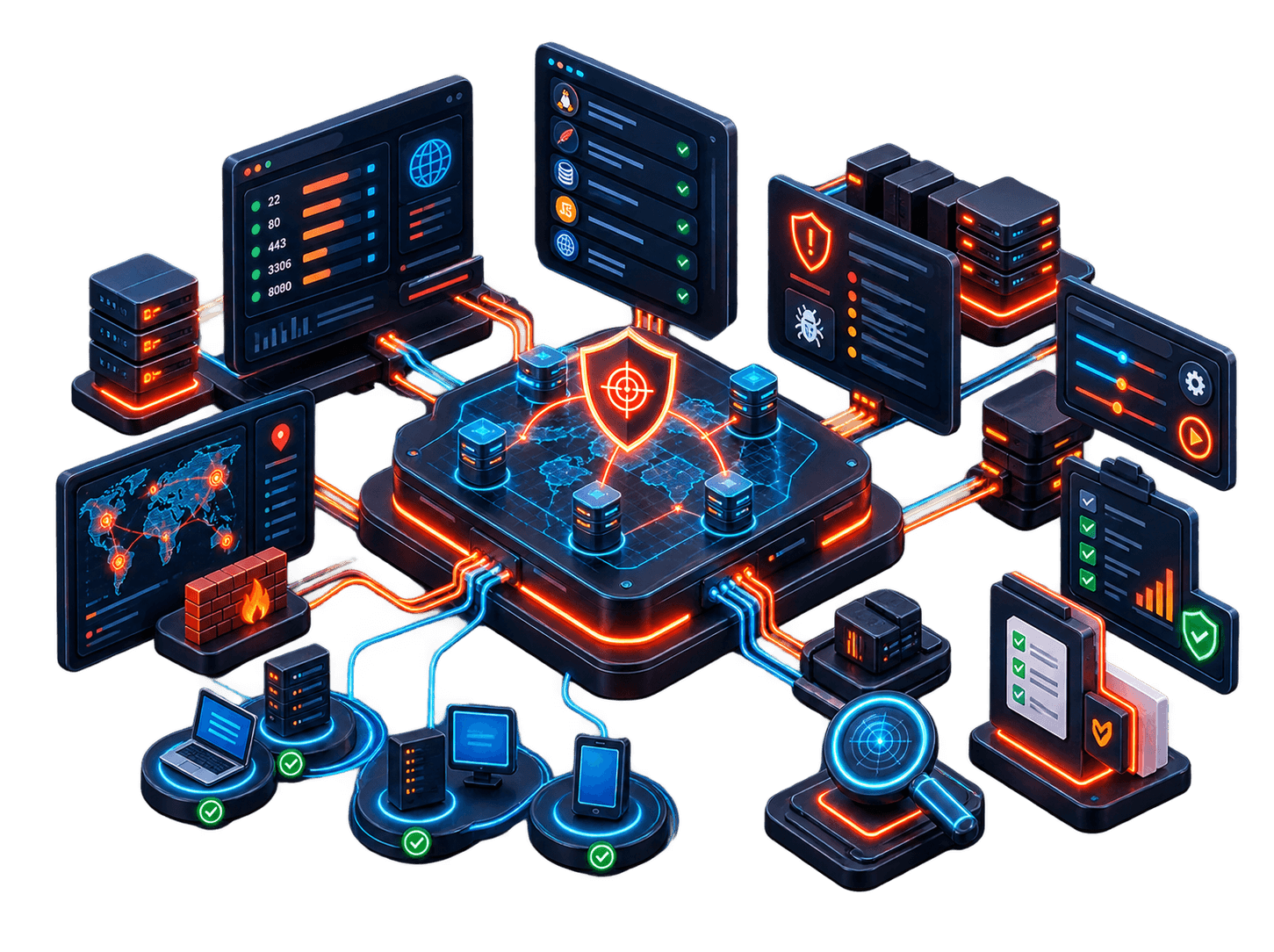
Pentestscanner brings network reconnaissance, vulnerability discovery, exploit validation and reporting into one workspace. Assess your authorized assets, investigate exposed services and turn potential weaknesses into actionable security findings.
Prove real risk: Use supported exploitation checks to validate critical vulnerabilities and collect actionable evidence.
Control your tests: Customize scan settings and select testing workflows that match your authorized assessment scope.
Explore your attack surface: Discover exposed services, subdomains, open ports and potential entry points across your assets.
Stay ahead of changes: Use scheduled scans and monitoring capabilities to identify changes and investigate newly discovered exposure.
Product Tour
Watch the demo
Speed up repetitive pentesting tasks, uncover exposed assets and connect findings into a clearer picture of your network attack surface.
Network pentesting in action
Built for Practitioners
Test your infrastructure faster. Prove more.
Cover your pentesting workflow from reconnaissance to reporting with tools designed to help you investigate and validate high-impact security issues.
One toolkit for the entire pentest
Move from reconnaissance to vulnerability scanning, exploit validation and reporting in one workspace without juggling separate tools.
Validate findings with real evidence
Use controlled exploitation checks to verify high-risk vulnerabilities and help your team distinguish confirmed risks from potential issues.
Control every testing workflow
Customize scan depth, configure testing options and adapt workflows to your infrastructure, assessment scope and security requirements.
Test external and internal networks
Assess internet-facing assets and, where configured, internal network environments to uncover exposed services, outdated software and misconfigurations.
One Connected Workflow
Support every stage of your network penetration test
From initial reconnaissance to validated findings and final reports, bring your network assessment workflow together in one place.
01
Map your attack surface with deep reconnaissance
Discover domains, subdomains, open ports, virtual hosts and exposed services across your authorized target environment. Identify potential entry points and collect the information needed to plan more focused penetration tests.
- Discover exposed assets and services
- Fingerprint technologies and versions
- Identify potential entry points
Port Scanner
Subdomain Finder
Domain Finder
Virtual Hosts Finder
Cloud Scanner
Network Discovery
Service Detection
Asset Discovery
02
Find vulnerabilities across your network
Scan authorized network assets for known vulnerabilities, outdated services, exposed ports and insecure configurations. Use the results to understand potential exposure and prioritize issues that deserve deeper investigation.
- Identify known CVEs and vulnerable services
- Review banners, versions and configurations
- Prioritize findings by potential risk
Network Vulnerability Scanner
Kubernetes Scanner
Password Auditor
03
Validate vulnerabilities and prove real risk
Investigate high-impact findings with controlled exploitation checks. Where a supported validation module is available, collect evidence that helps your team understand exploitability, reproduce the issue and prioritize remediation.
- Validate supported vulnerabilities
- Collect evidence for investigation
- Prioritize confirmed security risks
Sniper: Auto-Exploiter
SQLi Exploiter
04
Report findings and continuously monitor assets
Turn assessment results into structured reports for your security team or clients. Schedule recurring scans, track changes across your assets and use available integrations to connect findings with your existing workflows.
- Generate structured assessment reports
- Schedule recurring scans
- Track changes and new exposure
Pentest Reports
Scheduled Scans
Monitoring & Alerts
Transparent Performance
Evaluate vulnerability detection performance
Compare scanner detection results across defined test environments. Reliable benchmarks should use documented targets, repeatable test conditions and verified results.
01 / Web
Website vulnerability scanner benchmark
Review how different scanners identify vulnerabilities across intentionally vulnerable web applications. Use consistent test conditions to compare detection coverage.
Detection across both test targets
Scanner A
Scanner B
Scanner C
Scanner D
Scanner E
Scanner F
Illustrative values — not verified benchmark results
02 / Network
Network vulnerability scanner benchmark
Compare detection results across network test environments and remotely detectable vulnerabilities. Replace the example charts with measured results before making performance claims.
Benchmark results across test environments
A
Scanner
B
Scanner
C
Scanner
D
Scanner
E
Scanner
F
Scanner
Illustrative data — replace with verified results
Benchmark results for remotely detectable vulnerabilities
A
Scanner
B
Scanner
C
Scanner
D
Scanner
E
Scanner
F
Scanner
Illustrative data — replace with verified results
Customer Stories
Make network pentesting more actionable
Explore how validation evidence, repeatable testing workflows and structured reporting can help security teams communicate risk and plan remediation.
Get solid proof and accurate results
The most helpful thing about Sniper is being able to validate critical vulnerabilities for customers and demonstrate how an attacker could exploit them. Reliable proof-of-concepts help clients understand the risk and prioritize remediation. Limited testing also helps reduce the need for time-consuming manual exploitation.
Daniel Tomescu - Ethical Hacker and Senior Manager
Reference testimonial
Frequently asked questions
Everything you need to know before your first scan.
Yes. Scans are non-destructive and rate-limited by default, and any payload that could have side effects runs through sandboxed proof-of-concept validation instead of against your live system, so normal traffic and uptime are unaffected.