
AI Pentests
Autonomous web app pentests with proof
AI Pentests investigate your web application, follow attack paths, validate exploitability, and report findings backed by reproducible evidence. You define the scope, and the pentest runs from recon through to a report your team can act on.
Explore AI Pentests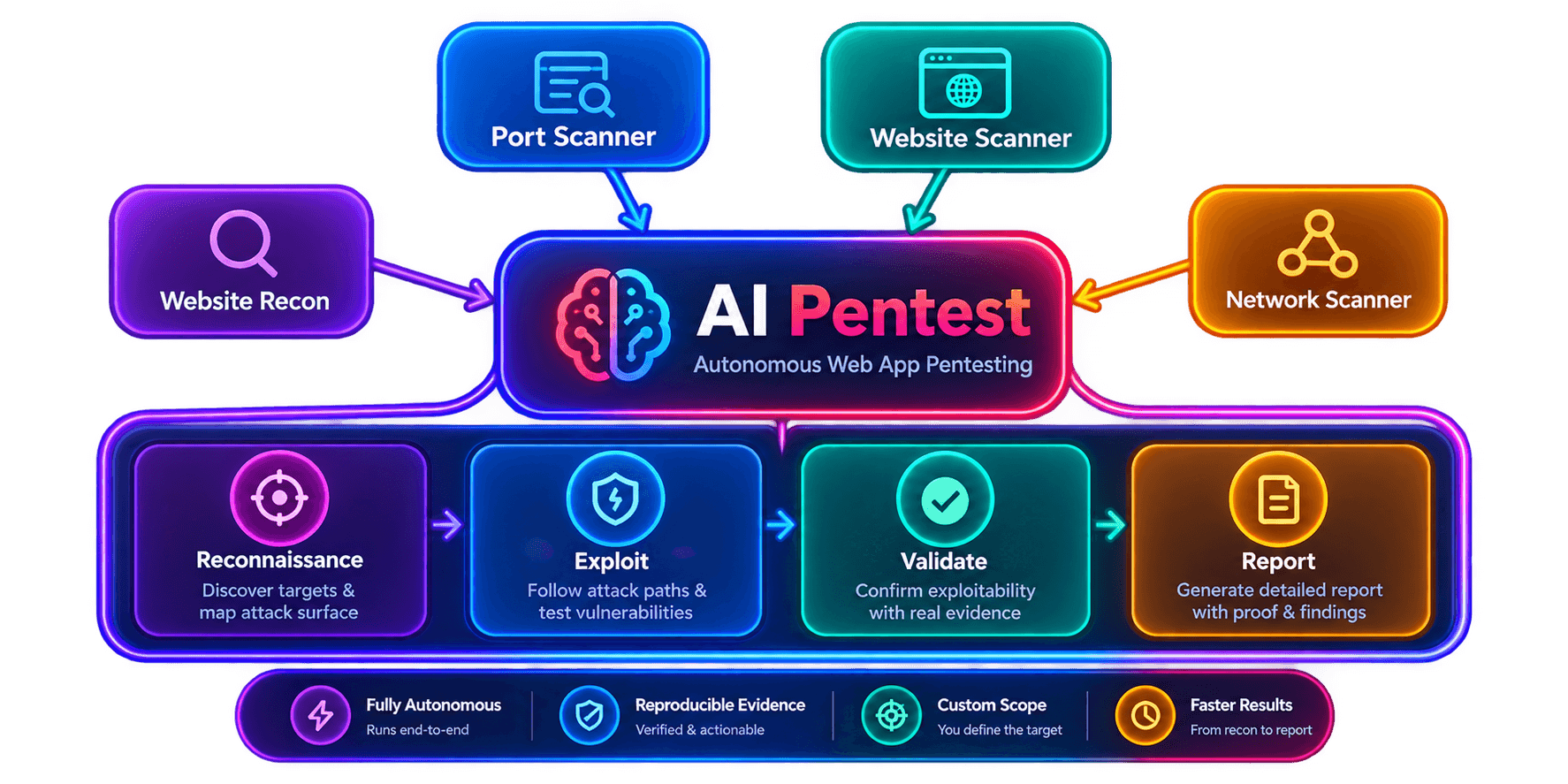
Built to Run a Full Penetration Test
Autonomous reasoning is only one part of an AI pentest. A complete engagement also needs validation, evidence, scope control, and reporting.
Autonomous Reasoning
AI explores your web application, forms hypotheses from how it behaves, and decides what to test next instead of following a fixed script.
Exploit Validation
Suspected issues are checked through controlled testing, so your report is built on findings that were actually confirmed.
Evidence Capture
Requests, responses, and supporting artifacts are collected along the way, giving your team proof to review rather than claims to trust.
Execution History
A record of what was tested and how makes the run transparent and easier to audit after the fact.
Scope Controls
You define the authorized targets. Testing stays inside the scope you set, so you stay in charge of what gets assessed.
Structured Reporting
Findings are organized with risk levels, evidence, and remediation guidance that technical teams and stakeholders can act on.
Another AI Tool? Here Is the Difference.
Your team deserves more than a chat prompt pointed at your website. AI Pentests pair AI reasoning with the scanning tools and validation steps that make results trustworthy.
Only run AI Pentests against applications you are authorized to test.
AI is only as good as the security knowledge behind it
A language model alone can suggest ideas, but a real pentest needs proven testing tools and offensive security logic to carry them out.
Validated findings, not guesses
Generic AI output often needs heavy manual checking. Here, a finding is meant to reach the report only after it has been confirmed.
Consistent, structured coverage
Established scanning tools provide a dependable base, so coverage does not depend on how a single prompt happens to be worded.
Reports you can hand to others
Results are organized into clear reports with evidence, supporting reviews by developers, clients, and auditors.
Pentest More Often, Without the Noise
Pentest More Often, Without the Triage Backlog
Frequent testing should not mean a growing pile of unverified alerts. Because each reported finding is backed by evidence, your team can spend its time fixing issues instead of proving they exist.
Test Exactly What Changes, When It Changes
When a new login flow or feature ships, you may not want to wait for the next scheduled engagement. Scope a run to one application or one flow and review the results as soon as testing completes.
Autonomy Backed by Proven Validation
AI reasoning decides where to look. Deterministic checks and controlled exploitation decide what counts as a finding.
Autonomy
Explores independently. It forms hypotheses from the application's behavior, tests them, and either gathers evidence or moves on.
Coverage
Chooses relevant tests based on context, spending more effort on the areas that matter instead of running the same checklist everywhere.
Depth
Follows attack paths across multiple steps, connecting weaknesses together when the evidence supports it.
Accuracy
Validates exploitability. A finding is meant to appear in the report only after controlled testing confirms it.
Visibility
Keeps testing transparent with a record of requests, responses, decisions, and the artifacts collected during the run.
Repeatability
Reports evidence you can verify yourself, including the steps to reproduce each finding, so your team can confirm it before fixing it.
Not Starting From a Blank Prompt
AI is changing penetration testing, but it does not replace offensive security expertise. AI Pentests build on the scanning and validation tools already in Pentestscanner.
Discovery
Subdomain Finder and Port Scanner help map hosts, services, and the exposed attack surface.
Content discovery
URL Fuzzer helps surface hidden paths and interfaces on the web services found.
Vulnerability scanning
The Website Vulnerability Scanner checks web applications for common weaknesses.
Validation
Sniper Scanner and sandboxed proof-of-concept testing help confirm that important findings are real.
From Scope to Proof-Backed Report
Define the scope
Choose the web application or flow you are authorized to test.
Map the target
Discover pages, endpoints, and technologies to understand how the application works.
Investigate
Form hypotheses, test them, and follow promising attack paths.
Validate
Confirm exploitability through controlled testing and capture evidence.
Report
Review proof-backed findings with risk levels and remediation guidance.
Who Can Benefit From AI Pentests?
Security Consultants
Cover more ground in each engagement and deliver findings backed by evidence your clients can verify.
Internal Security Teams
Test more often between scheduled assessments and focus review time on confirmed issues.
Managed Security Providers
Apply a consistent, well-documented testing approach across authorized client applications.
Development Teams
Check new features and changes soon after they ship, with reproducible steps that make fixes faster.
Frequently asked questions
Everything you need to know before your first scan.
Yes. Scans are non-destructive and rate-limited by default, and any payload that could have side effects runs through sandboxed proof-of-concept validation instead of against your live system, so normal traffic and uptime are unaffected.